Google Career Certificates vs IBM SkillsBuild vs freeCodeCamp: Which Learning Path Actually Fits You
Three names dominate the “learn digital skills without a degree” conversation, and they are not interchangeable. One is a paid, structured credential from Google. Another is IBM’s free corporate learning platform. The third is a charity whose free coding lessons and projects reach more than a million people a day, per its own about page. Choosing between them is less about which is “best” and more about what you are actually buying – because even the free options charge you in hours. All three appear on the bigger map in our guide to digital skills for your career.
The facts below come from each organization’s own pages, linked in Sources, including the footnotes behind their marketing numbers. Prices, program catalogs, and promotion terms are cited from each organization’s own pages as of October 2026 and can still change, so confirm them on the live pages before you commit.
Key takeaways
- Google Career Certificates are paid programs delivered on Coursera, designed to take 3-6 months at under 10 hours of study per week, per Google’s page. IBM SkillsBuild and freeCodeCamp are both 100% free, per their own pages – freeCodeCamp as a donor-funded charity.
- The headline outcome numbers are provider-reported and narrow: Google’s “70%+ positive career outcome” figure comes from a 2025 survey of US program graduates, and its “$102,000+ median salary” describes job postings across certificate fields (Lightcast US data, 2025), not what graduates actually earn.
- The three paths sell different things: a structured certificate issued by Google (a recognizable brand, not universal employer recognition), free brand-name skill introductions (IBM), and deep, project-based coding skill with free certifications (freeCodeCamp, about 300 hours per certification).
- In our judgment, the right pick is a sequence, not a winner: sample free first, pay for structure only if free has already proven you will finish.
Table of contents
- What each path actually is
- What each path really costs
- Reading the marketing numbers honestly
- Google vs IBM vs freeCodeCamp, side by side
- Where each path genuinely wins
- Choose by scenario, not by brand
- Common mistakes when choosing a learning path
- Google vs IBM vs freeCodeCamp: quick answers
- Sources
What each path actually is
Google Career Certificates: the paid, structured credential
Google’s certificates page pitches “job-ready skills you can put to work”: online, self-paced programs in fields like data analytics, project management, cybersecurity, digital marketing, and IT support, hosted on Coursera. Google states the programs take 3-6 months “with under 10 hours of flexible study per week” and require no prior experience.
Two things deserve attention. First, these are paid programs – enrollment runs through Coursera’s subscription, though Google’s page promotes enrollment bonuses like three months of Google AI Pro at no cost, with terms applied (per Google’s certificates page, the subscription costs $49 per month in the U.S. and Canada after a 7-day free trial, the price may be lower in other countries, and the AI Pro offer renews at $19.99 per month unless canceled). Second, what you finish with is a certificate from Google – a hiring signal, not an accredited degree, and Google’s own page frames it as making “your resume competitive,” not as a job guarantee.
IBM SkillsBuild: free, brand-backed introductions
IBM SkillsBuild describes itself as “100% free learning from a global leader in technology and innovation,” with content in more than 20 languages aimed at adult learners, university students, and high schoolers. Its catalog covers AI, cybersecurity, data, and workplace skills, organized into courses and learning pathways aligned to specific jobs.
The pitch is access, not a credential ladder: IBM frames SkillsBuild around building skills employers want and supports it with a corporate commitment to skill 30 million people globally by 2030. The program pages emphasize learning resources and real-world projects; what they do not promise is a hiring pipeline or a salary outcome.
freeCodeCamp: the charity with the longest hours
freeCodeCamp is a 501(c)(3) public charity. Its own FAQ is unambiguous: “Every aspect of freeCodeCamp is 100% free. The courses, the projects, even the certifications.” You learn by building dozens of projects step by step in your browser or editor, and each verified certification takes around 300 hours of dedicated learning, fully self-paced.
Two self-descriptions keep expectations honest. freeCodeCamp says it is not a coding bootcamp, and it explicitly warns it is not a replacement for a four-year degree – its FAQ even tells readers not to drop out of college for it. The organization’s evidence for outcomes is community-scale rather than survey-based: it says thousands of community members get their first developer job every year, and points to its alumni network on LinkedIn.
What each path really costs
Money is only one meter. The other is hours, and the three paths sit in very different places on both.
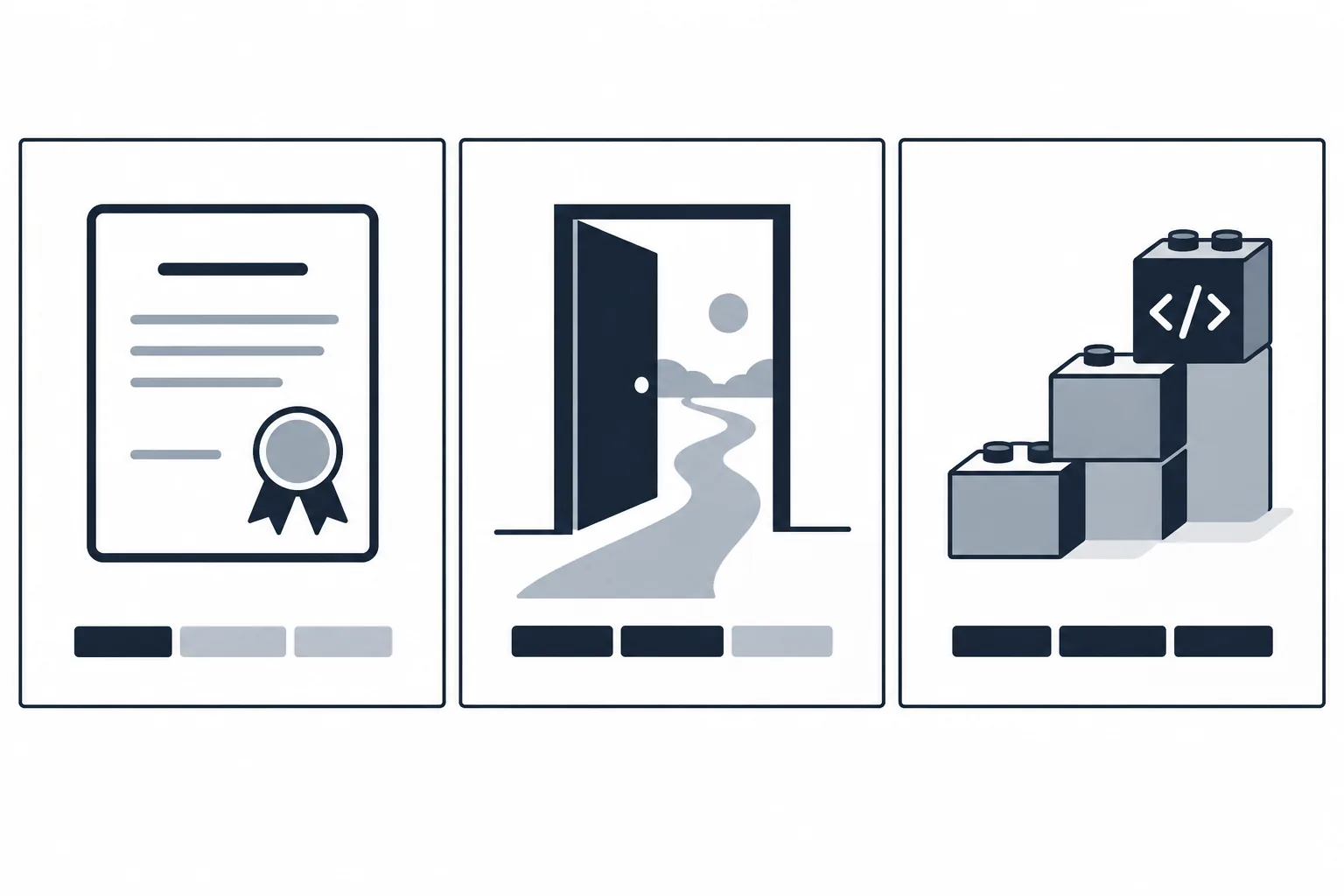
Three paths on the money and hours meters
Google Career Certificates cost money and save structure. Per Google’s certificates page, the Coursera subscription costs $49 per month in the U.S. and Canada after a 7-day free trial, may be lower in other countries, and financial aid is available via Coursera. In return you get a sequenced curriculum, deadlines you set yourself, graded projects, and a credential with a company name employers recognize.
IBM SkillsBuild costs no money at all, per IBM. The hours are the flexible part: short courses and pathways you can dip into, which makes it the cheapest way to test whether a field – cybersecurity, data, AI – holds your interest before you invest anywhere else.
freeCodeCamp costs no money either, per its FAQ, sustained by donations. The hour meter is the steepest: about 300 hours per certification. At ten hours a week, one certification is roughly seven months. The payoff is depth – hundreds of small projects that become portfolio evidence – rather than a brand-name badge.
None of the three charges hidden fees for finishing, per their own pages. The realistic budget question is therefore not “what does it cost” but “what do I do with the hours I have.”
Reading the marketing numbers honestly
Google’s page advertises “70%+ of certificate graduates report a positive career outcome (e.g., new job, promotion, or raise) within six months of completion.” The footnote says this is based on a program graduate survey, United States, 2025. That makes it a figure Google reports from its own survey: self-reported, from one country, among people who finished – it says nothing about those who dropped out, and “positive outcome” includes raises and promotions, not only new jobs.
The “$102,000+ median salary” and “1.7M+ job postings” figures carry a different footnote: Lightcast US job postings data for January to December 2025, across certificate fields. Those numbers describe the job market for the field, not what certificate holders earn. Treat them as evidence the fields are large, not as a salary forecast.
freeCodeCamp’s “thousands get their first developer job every year” is an organizational claim without a published survey behind it; its suggested verification is the public alumni network. IBM’s page leans on learner stories – real, but anecdotes by design. None of this makes the programs dishonest. It means the honest comparison is of structure, cost, and your own finishing probability – not of outcome promises.
Google vs IBM vs freeCodeCamp, side by side
| Factor | Google Career Certificates | IBM SkillsBuild | freeCodeCamp |
|---|---|---|---|
| Money cost | Paid, via Coursera subscription ($49 per month in the U.S. and Canada after a 7-day free trial; may be lower elsewhere, per Google) | 100% free, per IBM | 100% free, per its FAQ; donation-funded charity |
| Time cost | 3-6 months at under 10 hours/week, per Google | Flexible short courses and pathways (IBM lists credential durations from 4 hours to 65+ hours) | About 300 hours per certification, per its FAQ |
| What you earn | A Google-branded certificate | IBM skill credentials and course completions | Free verified certifications, built on dozens of projects |
| Teaching style | Sequenced video curriculum with graded projects | Short courses and job-aligned pathways | Learn-by-building, fully self-paced |
| Outcome evidence, as published | 70%+ positive outcome, US 2025 graduate survey (self-reported); salary/posting figures describe fields, not graduates | Learner stories; corporate skill-building commitment | “Thousands” of first developer jobs yearly, per the organization; alumni network as proof |
| Honest limitation | Not accredited; marketing stats are narrow | Introductions more than deep training | Steepest time commitment; self-described as not a degree replacement |
| Best fit, in our judgment | Career changers who finish things when there is structure | Testing a field at zero cost before committing | Future developers who learn by building and can self-direct for months |
This table summarizes each organization’s own pages, linked in Sources. Verify current program details before enrolling.
Where each path genuinely wins
Google Career Certificates: structure and signal. If you have started free courses and abandoned them, the problem was never content – it was follow-through. A sequenced program with graded work is, in our judgment, the strongest follow-through mechanism of the three, criterion: how much of the path is pre-organized so you only have to execute. The Google brand on a resume is a secondary benefit: recognizable, though not a job guarantee.
IBM SkillsBuild: zero-risk sampling. In our judgment it is the best first step of the three for someone who is not sure which digital skill to learn, criterion: cost of exploring a field you might abandon – which is zero money and modest hours. Use it to discover that you enjoy data work before paying anyone for a credential in it.
freeCodeCamp: depth and proof of work. For software development specifically, in our judgment freeCodeCamp offers the deepest skill-building of the three, criterion: volume of practical project work per finished credential. Employers hiring junior developers look at what you can build, and hundreds of projects are exactly that evidence. The price is the steepest time commitment of the three.
Choose by scenario, not by brand
“I need a credential on my resume within months, and I can pay.” Google Career Certificates. Pick the field closest to real job postings in your area, and treat the 3-6 month estimate as the honest floor.
“I am not sure what I want to learn yet.” IBM SkillsBuild. Sample cybersecurity, data, and AI courses until one holds your attention for a few weeks; then decide where to go deeper.
“I want to become a developer and I have time but no money.” freeCodeCamp. Budget about 300 hours per certification, build every project, and put the finished ones where employers can see them.
“I already work and just need AI and data literacy.” Start with IBM SkillsBuild’s short courses; if you want the credential too, a Google certificate in data analytics is the structured route.
Common mistakes when choosing a learning path
Reading field salaries as personal salaries. Google’s “$102,000+ median” describes job postings across certificate fields in US Lightcast data. It is evidence the field is large, not a forecast of your first offer.
Paying for structure you have not tested. If you have never finished a free course, finish one short freeCodeCamp or SkillsBuild course first. The cheapest structure is the kind you have already proven you use.
Collecting completions without projects. Course-completion badges show attendance. Projects show ability. Whichever path you pick, finish with things you built, not only certificates you hold.
Treating “free” as “no cost.” A 300-hour free certification costs about seven months of evenings. That is a fair price for a career change – but price it in before you start, not after you stall.
Google vs IBM vs freeCodeCamp: quick answers
Are Google Career Certificates free?
No. They are paid programs delivered through Coursera ($49 per month in the U.S. and Canada after a 7-day free trial, per Google, with financial aid available via Coursera; other countries may be lower). Google’s page promotes enrollment bonuses such as three months of Google AI Pro at no cost – that is a promotion with terms, not the tuition.
Is freeCodeCamp really free?
Yes, per its own FAQ: courses, projects, and certifications are all 100% free, funded by donations to its 501(c)(3) charity.
Is IBM SkillsBuild really free?
Yes, per IBM: “100% free learning,” in more than 20 languages, for adult learners, university students, and high school students.
Will any of these guarantee me a job?
None of them say that. Google reports a 70%+ positive outcome rate from a 2025 US graduate survey; freeCodeCamp points to its alumni network; IBM shares learner stories. All three are evidence of possibility, not promises.
Which one is fastest to something resume-worthy?
On published numbers: a Google certificate in 3-6 months at under 10 hours a week, or a freeCodeCamp certification in about 300 hours – whichever calendar fits you. IBM’s short courses can produce something resume-adjacent in days, but they signal exploration more than depth.
Sources
- Grow with Google, “Google Career Certificates” – program format, 3-6 months at under 10 hours/week, fields offered, and the footnoted outcome and salary figures (US graduate survey 2025; Lightcast US postings 2025): https://grow.google/certificates/
- IBM SkillsBuild – 100% free positioning, audiences, 20+ languages, course areas, and IBM’s 30-million-by-2030 commitment: https://skillsbuild.org/
- freeCodeCamp, “About freeCodeCamp – Frequently Asked Questions” – 501(c)(3) status, 100% free including certifications, about 300 hours per certification, not a bootcamp, not a degree replacement: https://www.freecodecamp.org/about/
- IBM SkillsBuild, “Digital credentials” – credential durations ranging from 4 hours to 65+ hours: https://skillsbuild.org/digital-credentials
GunaOne researches and writes with the help of AI tools. All sources are linked above so you can verify every claim yourself.