
From Zero to 100 Email Subscribers: A Beginner’s Plan
In this guide
- Why 100 email subscribers is the right first target
- Set up your list in one afternoon
- Create one signup incentive worth trading an email for
- The 5 places your first 100 email subscribers actually come from
- A weekly rhythm that keeps people subscribed
- What to measure from day one
- After 100: what changes
- Common mistakes
- Quick answers
- Sources
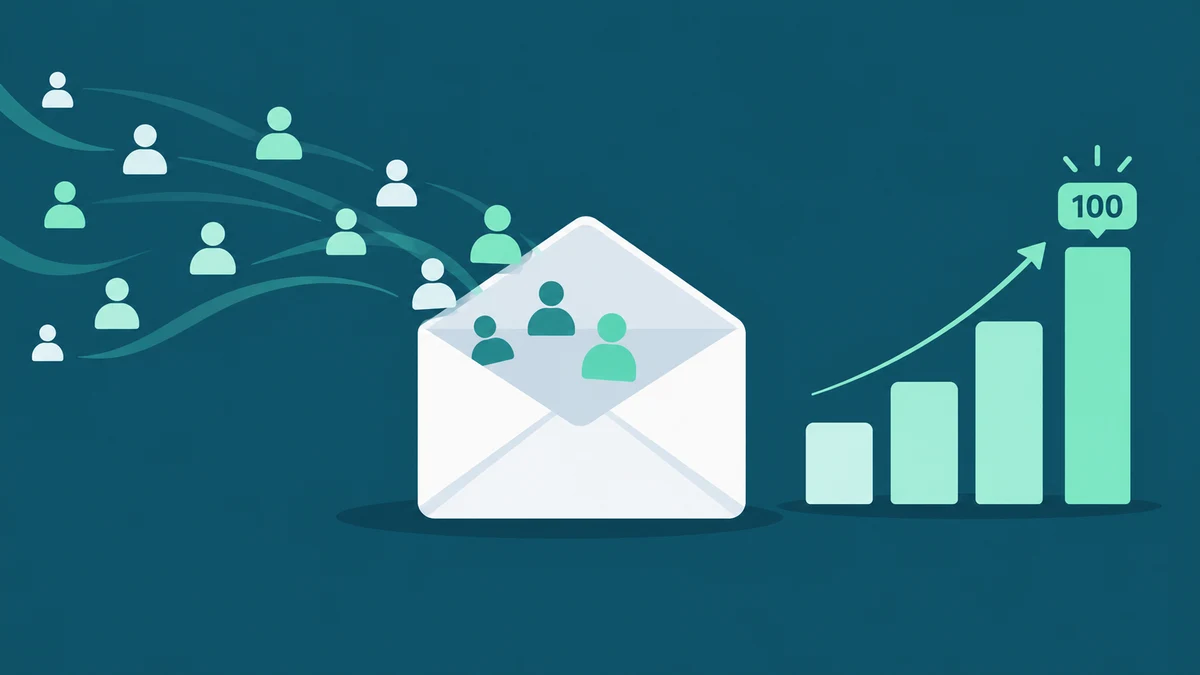
Most advice about email lists assumes you already have one. This plan starts from zero: no audience, no budget, no tool account. The goal is 100 email subscribers, because that is the point where a list stops being a theory and starts behaving like a channel. You will have enough people to see real open rates, enough replies to learn what readers want, and enough momentum to keep going.
The plan below takes about 90 days at a few hours a week. It is not fast, and that is the point. A small list of people who asked to hear from you beats a big list of people who did not.
Why 100 email subscribers is the right first target
One hundred is not an arbitrary round number. Below about 30 subscribers, your stats are noise: one friend opening every email makes your open rate look amazing, and one busy week makes it look dead. At 100, percentages start to mean something. If 45 people open, that is a real signal about your subject lines. If 8 click, you have learned something true about your content.
There is a second reason. Every list-building tactic that works at scale, from search traffic to partnerships, needs proof that strangers want what you send. Your first 100 email subscribers are that proof. They are also the people most likely to reply, and replies from readers are worth more at this stage than any metric.
Email is one channel inside a wider marketing mix, and it pairs especially well with search and social because you own the list itself. Our complete guide to digital marketing maps how those channels fit together, but nothing in it works until someone hands you an email address. So start here.
Set up your list in one afternoon
Pick a tool with a real free plan, create one list, and build one signup form. That is the whole afternoon.
Free plans differ more than you would expect, so check the current limits before you commit. As of November 2026, Mailchimp’s Free plan caps you at 250 contacts with 500 sends per month. beehiiv’s Launch plan is free up to 2,500 subscribers with unlimited sends. Kit’s free tier goes to 10,000 subscribers. For a first list of 100, any of the three works; the differences start to matter a few hundred subscribers later.

Two setup details matter more than the tool choice. First, send from a name and address people recognize, not a noreply address. Second, turn on double opt-in if the tool offers it. It costs you a few signups from people who never confirm, and it buys you a clean list that spam filters trust. The legal basics and the shape of your first three emails are covered in our email marketing guide for small businesses, so we will not repeat them here.
Create one signup incentive worth trading an email for
Nobody subscribes to “get updates.” People subscribe because they want something: a checklist, a template, a short guide, a discount, early access. Marketers call this a lead magnet, which makes it sound harder than it is. For a first list, one page is enough.
The best incentive for a beginner has three properties. It solves one narrow problem your audience actually has. It fits on one or two pages, so you can finish it this week. And it connects to what you will email about later, so the people who grab it are the people who want your emails.
A bookkeeping freelancer might offer a one-page tax deadline calendar. A small bakery might offer a weekly “what’s baking Saturday” list with early ordering. A web designer might offer a homepage checklist. Notice that none of these require design skills. A clean Google Doc exported to PDF beats a beautiful ebook that never ships.
Write the thing, export it, upload it to your email tool, and connect it to the signup form so new subscribers get it automatically. Every major free tool handles this without code.
The 5 places your first 100 email subscribers actually come from
Here is the part most guides skip: at zero subscribers, discovery tactics like SEO are too slow to be your engine. Your first 100 come from direct, slightly uncomfortable asks. The good news is that direct asks convert extremely well, far better than any cold channel, because there is already trust.
| Source | What to do | Realistic yield |
|---|---|---|
| People you already know | Message friends, family, and past clients personally; ask if they want in, never add them without asking | 10-25 |
| Your own profiles | Put the signup link in every bio, your email signature, and your pinned post | 5-15 |
| Communities you belong to | Answer questions genuinely; share the signup link only when it fits and the rules allow it | 10-20 |
| Your website or shop | Embed the form on your homepage, at the end of articles, and on a QR code at any physical counter | 10-30 |
| Subscribers sharing it | Ask readers to forward emails they liked; make the signup link easy to find inside every send | 10-20 |
Those ranges are illustrative planning estimates, not measured data or a promise; they exist to size the job, not to forecast your results. Add those ranges up and 100 stops looking abstract. Two or three of these sources, worked consistently for two months, get most beginners there. The personal asks feel awkward the first five times and fine after that.
One warning about the first row: adding people who did not say yes is not a gray area. It violates the US CAN-SPAM rules and most other countries’ equivalents, and it poisons your sender reputation before you have one. The FTC’s CAN-SPAM compliance guide spells out what permission-based sending requires.
A weekly rhythm that keeps people subscribed
Getting the signup is half the job. The other half is not giving people a reason to leave, and the main reason people leave a small list is silence followed by a sudden sales pitch.
Pick a weekly slot you can keep, such as Tuesday morning, and protect it. A sustainable weekly email for a beginner is short: one useful idea, one link or resource, one question readers can reply to. Two hundred words is fine. The US Small Business Administration’s email marketing basics make the same point: consistency and relevance beat volume.
Write the email you would want to receive from you. If you run a plant shop, that is “three plants that survive dark apartments” rather than “November newsletter.” Reply to every response you get. At 100 subscribers you can, and those replies tell you exactly what to write next week.
What to measure from day one
Free tools bury you in dashboards. Ignore most of it. Three numbers carry you to 100:
- Signup count per week. This is the plan’s scoreboard. Under 5 a week means your asks need to be more direct or more frequent.
- Open rate. For a small, permission-based list, 40% or higher is healthy. Falling opens usually mean your subject lines promise something the email does not deliver.
- Replies. Not a standard dashboard metric, so count them yourself. Replies are the earliest proof that real humans care.
Check these once a week, change one thing at a time, and resist redesigning your template. Nobody unsubscribes because the header was the wrong shade of blue.
After 100: what changes
Crossing 100 flips the job. Until now you pushed: asking people one by one, posting the link yourself, starting every conversation. Past 100, the list starts pulling a little. Subscribers forward emails. Your archive becomes content you can point people to. If you have a website, each new article gives search engines another reason to send strangers your way, and strangers who arrive from search convert to subscribers at a decent rate when the signup offer matches the article.
This is the moment to write down what you learned. Which source produced the most subscribers? Which email got the most replies? Double down on the two things that worked and drop the rest. The tactics that take a list from 100 to 1,000 are mostly the same ones, done with better data and a bit more patience.
Keep the weekly send above everything else. Lists die from neglect far more often than from bad subject lines.
Common mistakes
Waiting for the perfect incentive. A finished one-page checklist outperforms the 30-page ebook you never publish. Ship version one this week.
Buying a list. Purchased addresses did not choose you, do not open, and get your domain flagged by spam filters. It is the one shortcut that actively destroys the asset.
Collecting without sending. If someone signs up and hears nothing for six weeks, the first email feels like spam even though they asked for it. Send the welcome message immediately and keep the weekly rhythm from the first subscriber.
Promoting everywhere except where you already are. Beginners chase new channels while their email signature, bio, and homepage have no signup link. Fix the free real estate first.
Quitting at 40. Growth at this stage is lumpy: three quiet weeks, then 15 signups from one community thread. The plan works if you keep the rhythm through the flat weeks.
Quick answers
How long does it take to get 100 email subscribers?
For most beginners working a few hours a week, 60 to 90 days is realistic. It goes faster if you already have a website with traffic or an active community, and slower if you are starting from nothing and skip the direct asks.
Do I need a website to build an email list?
No. Every major email tool gives you a hosted signup page you can link from social profiles, messages, and a QR code. A website helps later, especially once search traffic starts, but it is not a prerequisite for the first 100.
Should I offer a discount or a free download?
Match the incentive to what subscribers want next. Product businesses do well with a small discount or early access. Service businesses and creators do better with a checklist, template, or short guide that shows how you think.
Is it legal to email customers who bought from me but never subscribed?
A purchase is not permission in most jurisdictions, and under CAN-SPAM you still must identify yourself honestly, include your postal address, and honor opt-outs promptly in every message. The safer and more effective path is to ask buyers to join the list at checkout or in a follow-up, and only email those who say yes.
What is a good open rate for a small list?
Small permission-based lists often see 40% to 60% because subscribers actually know the sender. Treat your own trend line as the benchmark: a sudden drop is the signal worth investigating, not the absolute number.
Sources
- US Federal Trade Commission: CAN-SPAM Act compliance guide for business (permission, identification, postal address, opt-out requirements)
- US Small Business Administration: Email marketing basics for small business (permission lists, consistency, signup incentives)
- Mailchimp: pricing plans help page (Free plan contact and send limits)
- beehiiv: pricing (Launch plan subscriber limit and send volume)
- Kit: help center (free tier subscriber limit)


2 Comments